Just go anywhere.
Meanderings early Saturday morning.

Just go anywhere.
Roatan, Bhutan, Goa, Galapagos.
Imagined places drift through my mind at 2:00 AM, creating lives in these far-off places, almost feeling the Indian fabrics brush against my skin, almost tasting the salty breeze on the South American shoreline, the comical blue-footed boobies doing their blue-footed things.
I am most awake, most alive OUT THERE. It’s where I figure out who I am. It’s where the texture of life shows up in unnamed food and cobblestone streets and colors and scents totally unfamiliar to me.
It’s when I don’t feel stuck in a jar. It’s like my regular life is held within a jar of marinara sauce. I love marinara. But when I’m in the jar, I can’t see the label. I can’t see what’s inside, I can’t read about the hands who made this homemade tomato stew, I can’t see the herbs and where they came from, I can’t see its name.
I can’t see who I am, who you are. All I see are the walls of the jar.
When I’m stuck, tired – feeling the weight of the world, feeling disconnected from the world, I find it again, I find me again, when I go into it. When I walk the back streets in Lilongwe, feeling the rich African old dirt kick up under my feet. When I engage with someone completely different than I, marveling at our dramatically different cultures and yet exact same human body. I laugh at brochures that say ,“ten cities in ten days!” – because these trips are drive-bys, like flashing through New York City for six hours on a layover and claiming to know exactly what it’s like to stand under a sequoia redwood tree, saying “I’ve been to the United States.”
You only began to know a place when you begin to see yourself in that place.
New places are like mirrors, if you care to look. They hold up information about you, about what you value, about what matters, about where your deepest strengths and most difficult challenges are. They push you. They challenge what is normal, how it’s “supposed” to happen.
But you have to leave the tourist zone to get there. Staring at the Eiffel tower is lovely – but it’s static. It doesn’t demand anything from you other than adoration.
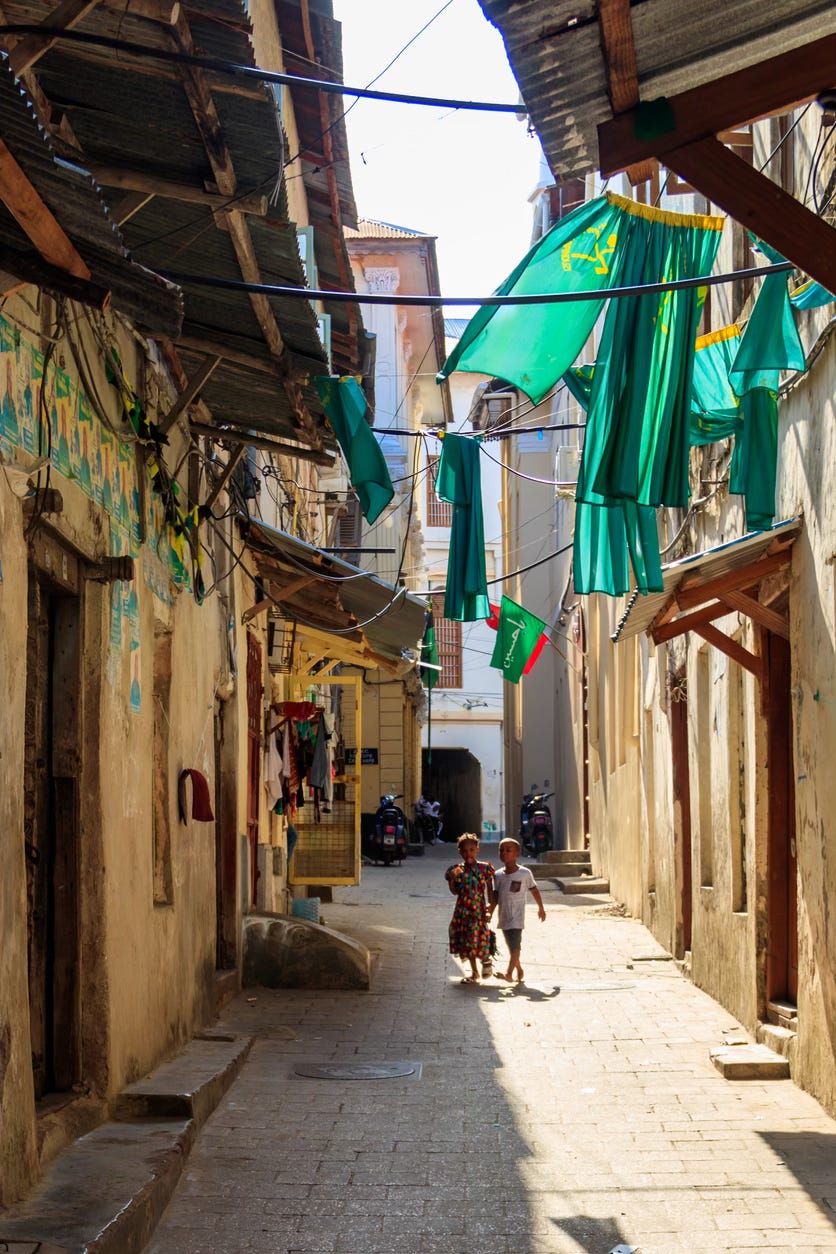
Instead, a side street of well- worn cobblestones in Zanzibar, men standing at the doorstep of their shop lining the alley, the heavy carved wooden Zanzibari door pushed open to reveal treasures from the Middle East and Egypt, their loose collarless robe, called a Kanzu, contrasting sharply with your shorts and t-shirt, overhead wires and clotheslines pinning the narrow alley together above, a brief hand of a woman washing her linens visible in the corner, the aromatic scents of fresh cinnamon bark and cardamon and black pepper, grown on the island, filling the hot humid air cooled in the alleyway. You can’t see the beginning or the end of this narrow path as you quickly move to the side as a piki piki roars past, the motorbike being the common mode of transportation, each holding anywhere from one to four people precariously perched on the seat. When the shouts in Arabic and Gujarati and Swahili and English remind you that your language is a minority here, that you are a minority here, that you are the strange one.
It’s that moment. When nothing is the same. Nothing.
It’s that moment you begin to see yourself, you begin to see the other, you begin to see,
when you finally begin.
That’s what I find when I leave. I re-find who I am. I re-find what matters. I discover things about the world I could not have imagined, I discover things about my own resilience and strength and courage and hope that too often I forget.
To travel, after all, is to remember.